Imagine you always have your products in your pocket. That’s not possible? Yes it is—with AR.
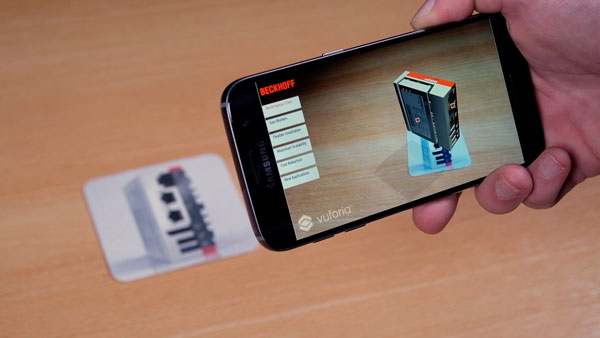
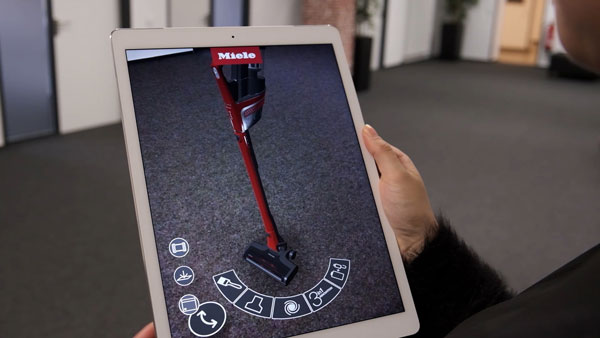
Imagine you always have your products in your pocket. That’s not possible? Yes it is—with AR. With mobile devices such as smartphones or tablets, or an AR headset, you can present your products virtually anywhere via an app. The user keeps their real environment in view while digital content such as films, animations, or interactive elements are seamlessly integrated into the environment. Perfect for presenting machines and equipment in a conference room or at a trade fair booth, or for providing technicians with instructions. In addition, augmented reality can be used on many mobile devices without great technical effort. Interested?
We are happy to advise you, directly at our agency in Bielefeld, at your location, or conveniently remote.
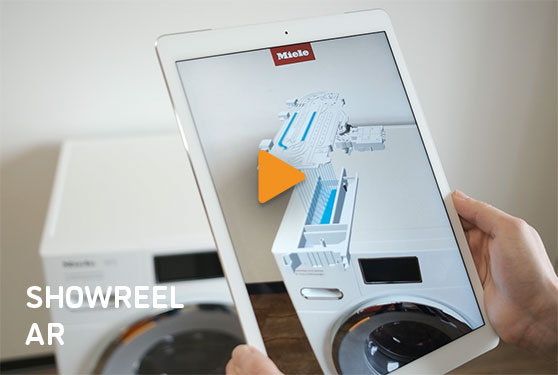
Augmented Reality (AR) means that the real environment is supplemented with virtual elements. The best-known example of this is probably interior design and furnishing apps that allow furniture and home furnishings to be virtually placed in your own home before purchase.
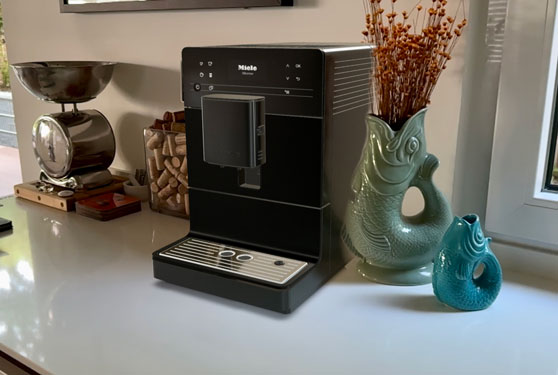
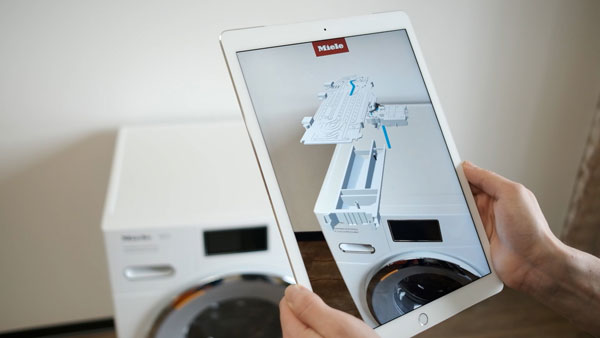
You place a 3D model in your real environment. Whether it is a large machine or a coffee machine. The 3D model can be viewed from all sides and configured, technical processes inside can be visualized or additional information can be provided via text.
All in real time and individually from your perspective. Immersive and exciting. AR also works via QR codes or image markers. This means you can also “send” your virtual product or make it available in your own app.
Through mixed reality, the interaction between the real world and virtual elements, completely new possibilities for interaction, information, and entertainment emerge. In industry, augmented reality is used for maintenance and repair purposes to provide instructions and information or to zoom into devices to examine their internal structure.
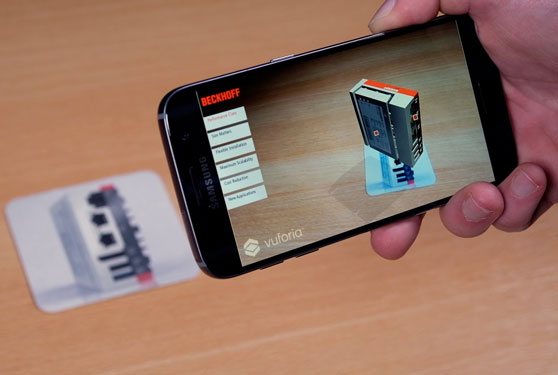
The retail sector uses this technology so that customers can virtually try out products in advance. In museums or during city tours, additional information or even guides can be accessed digitally, appearing as virtual figures in front of you and conveying further content.
In education, entirely new learning experiences can be created.
Why not illustrate complex content through interactive 3D models? The possibilities are diverse. As an agency for AR applications and interactive technologies, we offer tailor-made solutions for companies across different industries.
VR & AR are both immersive media. This means that both technologies enable users to immerse themselves in another world. With Augmented Reality (AR), the real environment is enhanced with virtual elements. Virtual Reality (VR) means completely immersing yourself in a virtual world. By putting on a VR headset, the real environment disappears and users find themselves in a completely different setting. Interested in virtual reality? Then go here: Virtual Reality
The most widespread use of AR is via mobile devices and apps. The usage is simple and accessible to everyone.
Simply open the app or scan an object or QR code with your camera, and virtual elements immediately extend your real environment. Apps enable enhanced functionality such as product configuration, accessing videos, or displaying text information. There are also headsets that enable an impressive AR experience, such as the Quest 3 or Quest Pro. Unlike pure VR headsets, such as the HTC Vive or others, AR glasses do not completely block out reality.
The user continues to see their real environment, only enhanced with virtual content. With AR glasses, the experience becomes even more immediate, as there is no mobile device between the user and the object. In addition, the hands remain free, allowing for further interaction.
Our AR agency consists of specialists who know exactly which technology is best suited for your production.
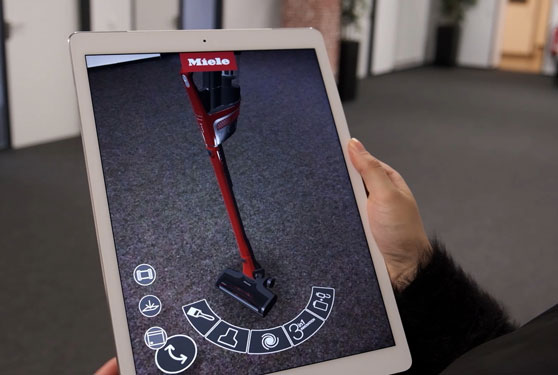
Do you want to know exactly how AR works? We have summarized the key points:
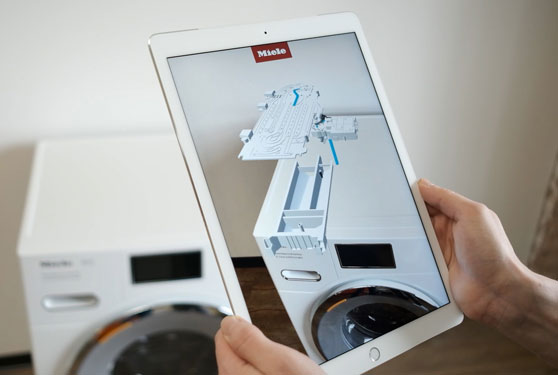
Augmented reality (AR) is a technology that enhances the real environment with digital
information. Users remain in the real world but see additional virtual content such as 3D models, text, or animations.
AR uses sensors and cameras in smartphones, tablets, or AR glasses to recognize the environment.
The software analyzes this data and places digital content appropriately within the real environment, where it can then be experienced interactively.
AR can often be used with a smart device such as a smartphone or tablet. These devices use camera
and motion sensors to display AR content. For more advanced or hands-free applications,
AR glasses or headsets can also be used.
AR is used in many areas:
AR enhances the product experience. Users can experience and test products virtually.
Companies can present their products independently of location, for example at trade fairs where space is limited. At the same time, AR can be used to improve efficiency in processes such as maintenance or training.
In general, you need:
AR enhances the real world with digital elements, while virtual reality (VR) completely
immerses the user in a virtual environment. AR therefore stays in the real world and extends it
instead of replacing it.